
Navigate this page to see the background of historical figures and events that are represented in The Greatest Showman.
P.T. Barnum
Phineas Taylor Barnum was born in Bethel, Connecticut on July 5th, 1810. He was born to Philo and Irena Barnum and group up in a poor family where he received a limited education in grammar school. After working as a grocery clerk for some time, Barnum realized he could capitalize on business and set up his own grocery store and ran a couple of lottery offices. During this period of his life, Barnum met his eventual wife Charity Hallett and they would go on to get married on November 4th, 1829 and raise four daughters.1 On September 7th, 1825, Barnum’s father would pass away at the age of 48 leaving his mother to take care of Barnum and his four younger siblings by herself.2
After some failures, Barnum moved to New York City to try and make a fortune for himself. After trying and failing to set up another grocery store, Barnum came across Joice Heth, who was in need of a new manager.3 Heth claimed she was the nurse for George Washington which would make her about 161 years old, although Barnum says in his autobiography that “she looked as if she might have been far older than her age as advertised.”4 Barnum found her stories fascinating and decided to profit off of them. He began to bring in $1,500 a week (which is about $51,500 today). Later in the 1870s, Barnum became involved in the circus business. He met a man with dwarfism named Admiral Dot, whom he decided to exploit using his odd height to make money. Barnum was later introduced to James A. Bailey and together, him, Bailey, and a couple other men created “The Greatest Show on Earth.”5

Charity Barnum
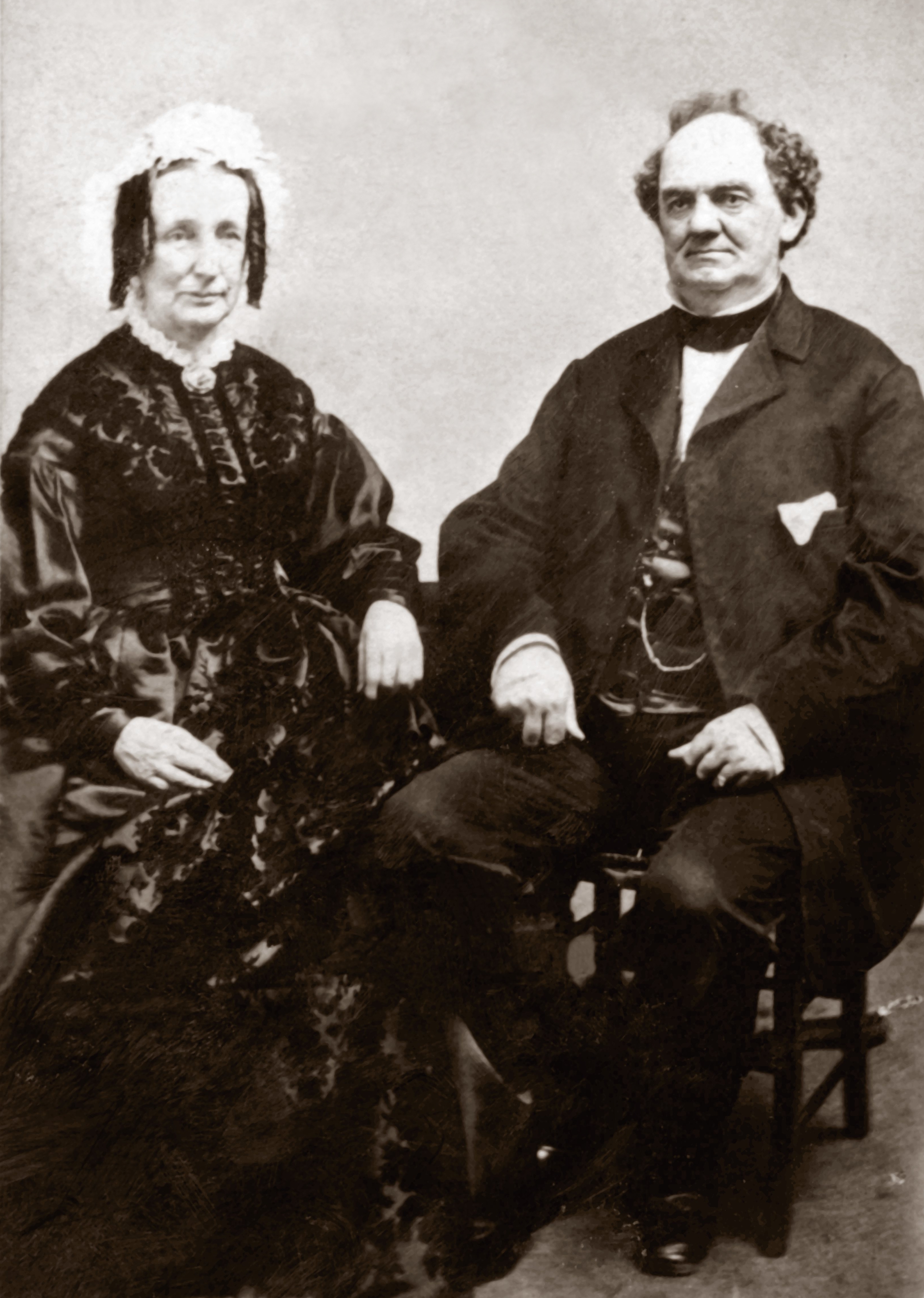
Charity Hallett (also known as “Chairy”) was born in Bethel, Connecticut in 1808 and worked in a tailor shop for most of her early life before she met P.T. Barnum. The couple met when Barnum was asked to escort a “fair, rosy-cheeked” girl that was too afraid to ride home in a storm. Barnum is said to have wished the ride was longer as her face haunted him at night.8 After a few years of courting, the couple got married in November of 1829 and stayed together for 44 years until Charity died. Charity wholeheartedly supported Barnum’s business ventures despite the fact that she was chronically ill for most of her life. Barnum and his friends often made Charity the butt of their jokes for being “too proper,” although many also described her as being too good for Barnum.9
Jenny Lind
Jenny Lind, also known as “The Swedish Nightingale,” was born in Stockholm, Sweden in 1820. Lind had already had an established career by the time Barnum came across her. She was well-loved by all and even received a standing ovation during her debut performance in Her Majesty’s Theatre. It was during this performance in 1847 that Barnum and Lind’s paths crossed.10 Barnum then proposed his idea of an American tour to Lind in 1849 after him and Tom Thumb parted ways with each other.11 It was safe to say that the debut performance for the tour was a great success. After 95 concerts, the tour ended with Lind deciding to part ways with Barnum due to her tiring of Barnum’s need for publicity.12

The Circus

Barnum’s “act” began after he started profiting from Joice Heth’s stories. He soon set out to find other business ventures and first landed on wax figures, mirrors, and other “odd” items. He called his new enterprise “Barnum’s American Museum” and opened it in 1842. The museum gained popularity and became a well-liked attraction in New York City. Barnum also expanded into the world of “abnormal humans” which he traveled with as a troupe, displaying for people’s entertainment. Some members included General Tom Thumb (Charles Stratton) who stood at two feet tall, a set of conjoined twins named Chang and Eng, and others.15 The actual idea of the circus had already been created in the late 18th century,16 but Barnum “perfected” it, as some would say, by making it the largest version of the circus to exist. “The Greatest Show on Earth” was created by Barnum and W.C. Coup and was officially titled a “Grand Traveling Museum.” This company would later be re-named Barnum & Bailey.17
- Sara Ann McGill, P.T. Barnum (Great Neck Publishing, 2017). ↩︎
- Phineas Taylor Barnum, The Life of P.T. Barnum: Written by Himself (Courier Company, 1888), 23. ↩︎
- McGill, P.T. Barnum. ↩︎
- Barnum, The Life of P.T. Barnum, 38. ↩︎
- McGill, P.T. Barnum. ↩︎
- Charles D. Fredricks & Co. P.T. Barnum. 1860-1864. Photograph. Retrieved from the Library of Congress, https://www.loc.gov/item/2013648325/. ↩︎
- Unknown. P.T. and Charity Hallett Barnum. 1860. Photograph. Retrieved from Wikipedia Commons, https://commons.wikimedia.org/wiki/File:P.T._and_Charity_Hallett_Barnum_c1860.jpg. ↩︎
- Barnum, The Life of P.T. Barnum, 24; 30. ↩︎
- Betsy Golden Kellem, “P.T. Barnum’s Unwavering Love: The Inspiring Journey of Charity Barnum.” BarnumMuseum, November 22, 2021. Video, 1 min., 15 sec. https://www.youtube.com/watch?app=desktop&v=Kmk67gP08DM. ↩︎
- Robert Wilson, Barnum: An American Life (Simon & Schuster, 2019), 123-4. ↩︎
- Barnum, The Life of P.T. Barnum, 296. ↩︎
- Barnum, The Life of P.T. Barnum, 341-3. ↩︎
- Brady-Handy Photograph Collection. Jenny Lind. 1855-1865. Photograph. Retrieved from the Library of Congress, https://www.loc.gov/item/2013648325/. ↩︎
- The Barnum & Bailey Greatest Show on Earth: Portraits of P.T. Barnum and J.A. Bailey. 1897. Poster. Retrieved from the Library of Congress, https://www.loc.gov/item/2002719029/. ↩︎
- McGill, P.T. Barnum. ↩︎
- Matthew Wittmann, “The Origins and Growth of the Modern Circus,” in The Cambridge Companion to the Circus, ed. Gillian Arrigh and Jim Davis (Cambridge University Press, 2021), 19. ↩︎
- Gillian Arrigh and Jim Davis, eds., The Cambridge Companion to the Circus (Cambridge University Press, 2021), xxiii. ↩︎